


Of course there are many aspects to SEO and a lot more to take control of within the plugin. But the configuration wizard, combined with our SEO knowledge, means that we can configure most of the plugin’s general settings for you, so, you can focus on what’s most important – your content!
SEO analysis
You’ll see our content analysis controls when you start writing a post or page. In WordPress, you’ll find the Yoast meta box right below the text area where you write your content:
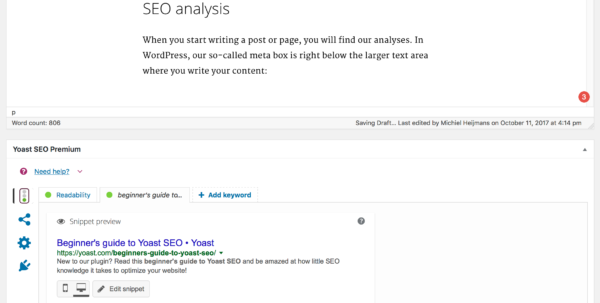
You’re going to find the Yoast SEO box very useful. As you can see, there are a couple of tabs here.
- In the first tab you can insert the keyword you want to optimize the page for – the focus keyword. For this post it’s: ‘Beginner’s guide to Yoast SEO’. This tab also includes the SEO analysis.
- The second tab is marked ‘Readability’.We’ll get to that later.
Under the tab where you can insert that focus keyword, we’ll tell you if you have used that focus keyword the right way in that specific post.
Our SEO analysis
Our SEO analysis currently includes the following checks:
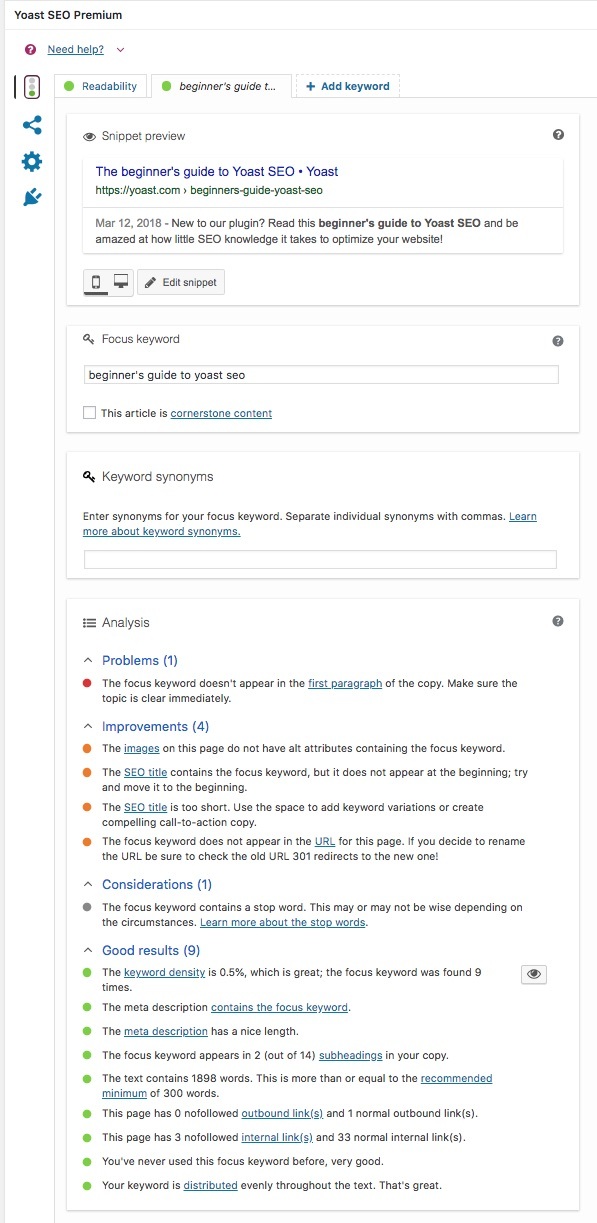
- In the image above you can see how we analyze different aspects of your text:
- If you want your page to rank for a specific keyword, you need to write at least 300 words on the subject, or risk it being considered a ‘thin content‘ page by Google – and you want to avoid that.
- Add a meta description that includes the focus keyword. People searching that term on Google will see this in search results, so make it enticing to click on.
- You want to make clear right from the start what the page is about, so start adding the focus keyword from the start.
- Add images to create a better experience for your users. Use the focus keyword in the ALT text so that Google can relate that image to the keyword.
- To set up a proper site structure, link to at least one other related page on your site. It keeps visitors on your site and shows them more (background) information.
- We want sites to link to other websites as well, as this opens up the web. Link to other websites that back up the points in your blog posts, or provide further information. This will help Google work out which websites relate to each other on what subjects.
- A short page title allows you to add a trigger for a visitor from Google to click to your website.
- If you add your focus keyword at the beginning of your page title, it will have the most value. Also, it will immediately stand out when your post is shared
- Repeat your focus keyword in your URL. This makes it clear – even out of context – what your page is about. And Google also likes seeing it in there.
- You should optimize a single page for a certain keyword – not an entire website, so don’t create pages that compete with each other! Yoast SEO will warn you if you write more than one post about the same keyword. A simple solution is to use a variation or a long tail keyword.
In Yoast SEO Premium, you can now optimize for keyword synonyms as well. And we plan on releasing many more features in the upcoming period, so stay tuned.
More features: Cornerstone content and snippet preview
If your page is the main page for a particular topic or keyword in a group of pages you plan to write, you can mark it as cornerstone content. But then this probably isn’t a subject for a beginner’s guide to Yoast SEO! It might be wise to take our basic SEO course first :)
As well as all the checks, we provide an editable snippet preview, which shows you how our plugin displays your page to Google and other search engines.
Readability analysis
Since SEO is one of those areas where content is indeed king, we also provide a convenient readability analysis for you. That’s because we understand not everyone has the skills to easily create readable content. I laughed out loud when I heard that someone thought it would be a good idea to use our readability analysis to analyze the readability of books and even Hamlet’s first soliloquy by William Shakespeare. Oh, the time wasted! If Hemingway was around today and writing a blog, he’d probably love our readability analysis. It would allow him to translate his offline writing into nice readable web-friendly content. We have a post called “Yoast SEO hates my writing style” that goes into these common misconceptions.
Online vs. offline
If you’re going to write website content, you need to understand that online and offline writing are two different things. While we take the time to read, digest and daydream about all the great stories we read in books, we tend to scan, process and use the things we read online. Reading a book like Hemingway’s ‘The Old Man and The Sea’, we feel the man’s frustration and motivation as he struggles with a marlin for days in his tiny boat on the lonely sea. But, as this beginner’s guide to Yoast SEO is on a website, you probably just scanned it to see if there’s something here you didn’t know already.
This post isn’t a page in a book. It’s information for you to process like most online pages are and we wrote our readability analysis with that purpose in mind.
Government rulings
As you may know, Yoast is based in the Netherlands, where the law requires that the text on all government websites should be at B2: Upper intermediate level. It’s a rule that makes sure that every citizen, regardless of the level of education, can read and understand the information on these websites. We aim to help them with that. Our readability analysis works for websites in English, Spanish, Dutch, French, German, and Italian by the way.
The readability analysis
Now let’s see what’s in our readability analysis:
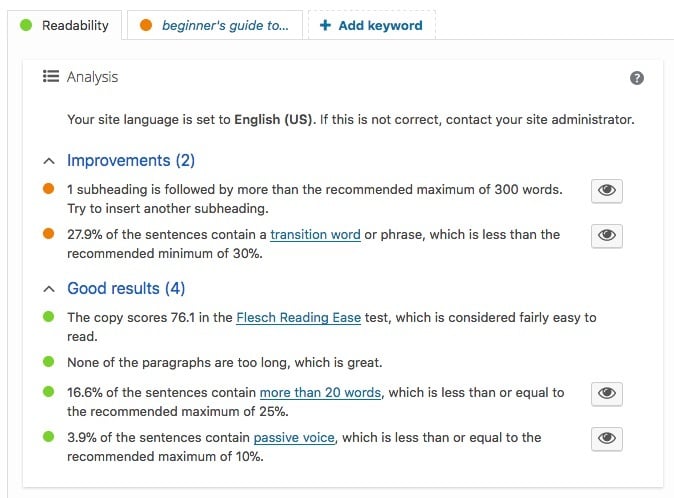
We analyze:
- Use of headings and subheadings so that people can scan your pages faster. Headings help you group topics, which makes it easier to process them.
- Readability score: the Flesch Reading Ease test makes sure every reader can understand your writing. If you are writing for a more educated audience, a lower score is more acceptable – it’s a guideline, you decide how strictly to follow it.
- Use of transition words to help improve the ‘flow’ of your page. They send a signal to your visitors that something is coming up and prepares them for the next sentence. You’ll find that the recommendation of using transition words in 30% of your sentences isn’t that hard to do.
- Paragraph length: long paragraphs in an online article are more difficult to understand as readers find themselves lost in all the words. Bite-sized chunks of text are easier to process.
- Sentence length: while in a book you can stretch a sentence over half a page, shorter sentences are that much easier to read online. We use 20 words as a target length.
- Use of passive voice: passive voice distances you from the reader, while active voice is much more engaging. It’s almost impossible to write a ‘natural’ article without any passive voice at all (IMHO), which is why we ‘allow’ 10% passive voice in our analysis.
If you want more insight into how we decided on all these criteria, see Content analysis: methodological choices explained.


No comments:
Post a Comment